First-Flushed Matcha Powder for Cafés & Coffee Shops | BYG Matcha
Matcha for Cafés & Coffee Shops
Choose matcha for the drink you're making — not just the grade on the bag. BYG helps cafés compare colour, flavour, milk performance, dosage and cost per cup.
The Best Café Matcha Depends on What You're Serving
Matcha served traditionally with water needs different qualities from matcha served with oat milk, strawberry purée or vanilla syrup.
| Your Drink | What Matters Most | What to Look For |
|---|---|---|
| Traditional Matcha | Umami, aroma, smoothness | Fine, delicate matcha with low astringency |
| Premium Matcha Latte | Colour, smoothness, flavour | Matcha that remains distinctive after milk |
| Oat Matcha Latte | Body and colour | Enough matcha character to balance creamy oat milk |
| Strawberry Matcha | Colour and flavour intensity | Vibrant matcha that remains noticeable |
| Vanilla / Syrup Matcha | Flavour strength | Matcha that doesn't disappear behind sweetness |
| Bakery & Desserts | Colour, flavour, value | Matcha selected for food applications |
Does Your Café Really Need It?
Not always.
If matcha is served with water, subtle aroma, umami and low astringency can matter enormously.
But once you add milk, syrups, fruit purées or other ingredients, some of those delicate characteristics become much less noticeable.
For Café Drinks, Test:
- Colour after adding milk
- Flavour intensity
- Smoothness
- Astringency
- Umami
- Consistency
- Dosage required
- Cost per serving
Choose matcha for the drink — not the marketing terminology.
What Makes a Good Café Matcha Latte?
Colour
Matcha should maintain an attractive green appearance after milk is added, especially for iced and layered drinks.
Flavour
Milk softens matcha. The powder needs enough character to remain noticeable without becoming excessively bitter.
Smoothness
Fine powder characteristics and correct preparation help create a smoother, more refined latte texture.
Consistency
A café needs a recipe that can be reproduced consistently between baristas and service periods.
Milk Performance
Matcha should be tested with the exact dairy or plant-based milk used in your café.
Commercial Value
Don't judge value only by price per kilogram. Compare the dosage required to make the drink you actually want.
Don't Compare Matcha Only by Price per Kilogram
Compare the real matcha cost per cup.
“A cheaper matcha is not necessarily cheaper if you need more powder to achieve the colour and flavour your customer expects.”
Test Matcha With the Milk You Actually Serve
A matcha that tastes excellent with water may behave very differently after 150–200ml of milk is added.
Strawberry, Vanilla, Pistachio & More
Modern matcha menus go far beyond a traditional latte.
Once fruit, syrups, cold foam or cream toppings are added, the matcha needs sufficient colour and flavour intensity to stay present.
For flavoured matcha, prioritise:
- Strong natural colour
- Recognisable matcha flavour
- Smooth texture
- Consistency
- Commercially sensible dosage
Don't ask “Which matcha has the highest grade?” Ask “Which matcha makes this drink taste best?”
Fine Matcha Matters
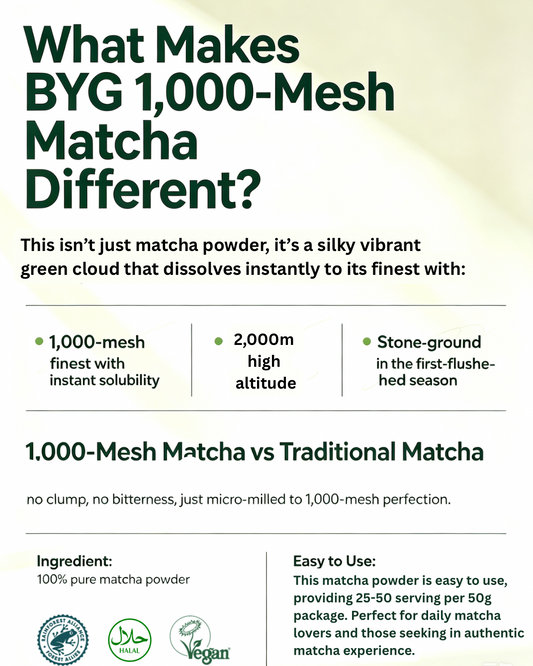
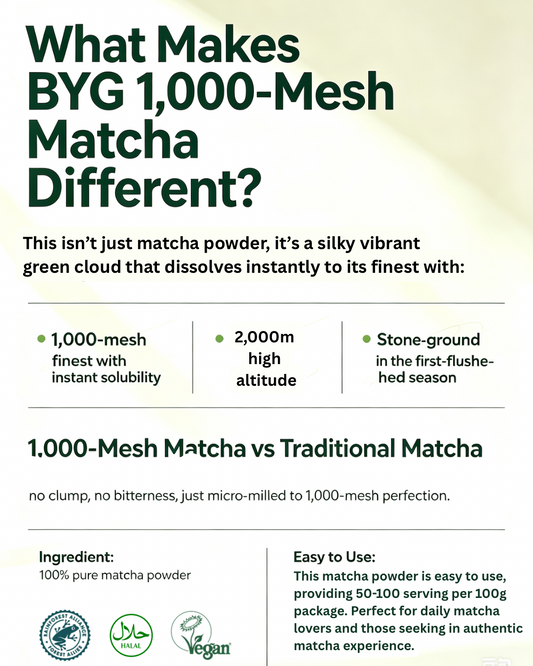
Selected BYG Matcha products use our 1,000-mesh specification as part of our focus on an exceptionally smooth matcha experience.
Smooth Mouthfeel
Fine powder characteristics can help reduce the perception of grittiness when properly prepared.
Easy Dispersion
Matcha forms a suspension rather than truly dissolving in water, making preparation and particle characteristics important.
Latte Texture
A finer, well-prepared matcha can contribute to a more refined drinking experience.
Start With 3g. Then Test.
Every café should develop its own recipe, but this is a useful starting point.
40ml Water at approximately 75–80°C
180ml Milk
Prepare your measured matcha.
Avoid boiling water, which can emphasise bitterness.
Aim for a smooth suspension before adding milk.
Test hot and iced versions.
Choose the dosage that balances taste and cost.
Try BYG Matcha in Your Café
Use your milk. Your cup. Your baristas. Your recipe. Then compare colour, flavour, smoothness, dosage and cost per cup.
Frequently Asked Questions
What is the best matcha powder for a café?
Does a café need ceremonial grade matcha?
How much matcha should a café use per latte?
How many matcha lattes can 1kg make?
Can BYG Matcha be used for strawberry matcha?
Does BYG offer wholesale matcha?
Explore Wholesale Matcha →
Can I test BYG Matcha before choosing it for my café?
Find the Matcha That Works for Your Drink
Your café doesn't need the matcha with the best marketing label. It needs the matcha that works with your milk, recipe, dosage and target cost per cup.
Only First-Fushed With Its Finest
-
BYG Finest Matcha Powder, 1,000-Mesh — 50g | Smooth, Vibrant, Non-Bitter
Regular price $13.00 USDRegular price -
BYG Finest Matcha Powder, 1,000-Mesh — 2 × 100g Pouches | Smooth, Vibrant, Non-Bitter
Regular price $27.00 USDRegular price